Earendil Cracks the AI Agent Problem With Minimalist Pi Harness
By separating raw model intelligence from execution environments, an open-source tool with 51,700 GitHub stars is sending 3x less context per turn—and getting better results.
For the last two years, the tech industry has treated large language models like magical, omnipotent brains. But developers quickly discovered that handing a raw neural network a massive list of APIs is like dropping a theoretical physicist into an airplane cockpit with a thousand unlabeled buttons. The result isn't magic; it's a confused, hallucinating AI that gets stuck in infinite execution loops. Now, a viral essay and a surging open-source project are changing how developers build autonomous systems by formalizing a simple, profound rule: a model is not an agent.
The Operating System for Artificial Intelligence
In late August 2026, Colin Daymond Hanna, co-founder of the public benefit corporation Earendil, published an essay titled 'What Is a Harness?' that immediately took over Hacker News. His central thesis is elegant: an agent is a model plus a harness. If the large language model is the CPU generating probabilistic predictions, the harness is the operating system. It provides the memory management, the executable tools, and the rigid state machine needed to turn raw intelligence into reliable action. Tech analysts now break this operational scaffold down into four distinct pillars: a system prompt that acts as an onboarding manual, executable tools for terminal commands, an agentic loop for multi-step reasoning, and a multi-model translation layer. By standardizing these elements, developers are solving the bloated context problem. When you feed a model entire OpenAPI specifications, it degrades performance. But when you strip the environment down to a minimal, hyper-focused core—read, write, edit, bash—the model can reason without distraction. This philosophy of context minimalism is best embodied by Pi, an open-source terminal harness created by Mario Zechner and acquired by Earendil in April 2026. Zechner's pitch for the project captures its hacker ethos: 'There are many agent harnesses, but this one is yours.' It functions much like Neovim—a highly hackable, composable environment that stands in stark contrast to rigid, bloated IDEs. The performance gains are undeniable. In an August internal benchmark, Databricks tested Pi on a multi-million line codebase using Anthropic's Opus 4.8. Pi achieved the highest pass rate of any tool tested, finishing tasks in fewer runs while sending three times less context per turn than enterprise alternatives like Claude Code. The community response has been massive, with Pi amassing over 51,700 GitHub stars and becoming the underlying engine for major projects like OpenClaw.
Forging Durable AI Workflows
The real breakthrough of the AI harness isn't just about writing code faster. It's about fixing the notorious handoff problem in autonomous workflows. Historically, as AI tasks became complex, passing context from a coding agent to a code-review agent turned into a messy, state-losing disaster. Harnesses solve this by introducing deterministic state machines. Instead of letting an AI wander aimlessly through a task, the harness clears the context upon completion, packages a clean artifact, and passes it to the next specialized agent in the loop. Third-party developers are already building workflow graphs directly into Pi, allowing models to run complex Socratic reasoning loops before executing a single line of code. As one Hacker News commenter noted, once you let the agent reason about the work and only provide guardrails, the frontier models suddenly outperform highly prescriptive human coding. This movement signals a crucial maturation in how we deploy artificial intelligence. As models hit a plateau in raw competence, the frontier of innovation has shifted from the brain to the scaffolding around it. Earendil is tackling this future head-on, balancing open-source community building with an enterprise model they call Win-Win Transactions, protecting their core engine via trademark rather than restrictive licensing. Ultimately, the rise of the harness is about control. It represents a rejection of the passive consumption of black-box AI behavior in favor of deterministic, developer-led architecture. Earendil’s mission is to ensure humans remain the directors of this technology. As Hanna wrote, the ultimate goal of the harness is to ensure we wield the hammer, rather than allowing the hammer to wield us.
“As models hit a plateau in raw competence, the frontier of innovation has shifted from the brain to the scaffolding around it.”
What people are saying

“This week we read research from a team of academics that ran a software task across 7 agents and 5 models. They found that in domains with a mature CLI ecosystem, agents without MCP baked in completed the task just as reliably and were 5-28x cheaper. Full arXiv paper below”
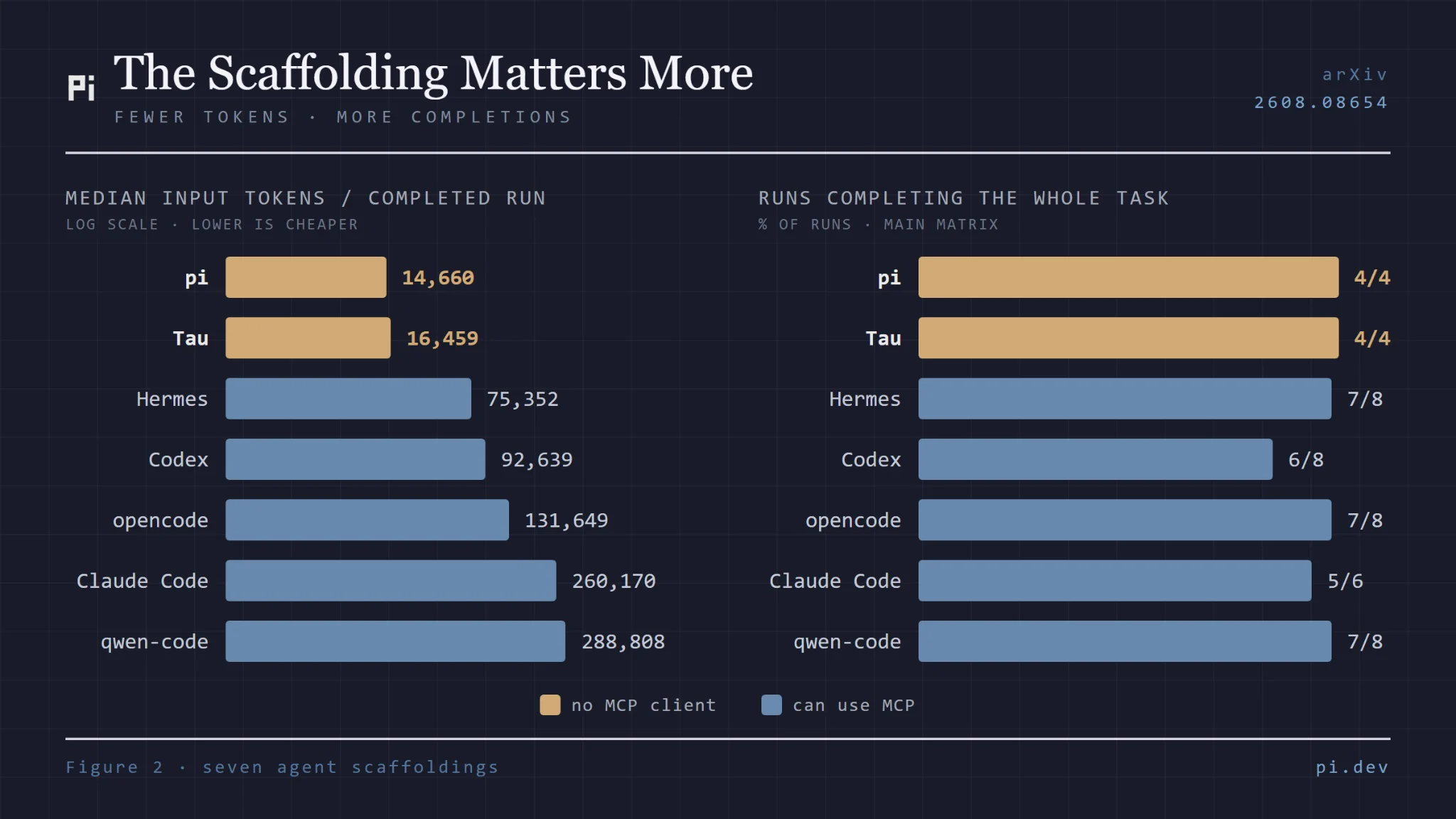

“We tested DeepSeek V4 Pro 0813 across 5 different agent harnesses on 30 challenging agentic tasks. We compared Claude Code, DeepSeek Harness 0.1, Hermes, Pi Agent, and OpenCode. Pi Agent solved the most tasks, while DeepSeek’s own harness won on cost. 🧵🧵”


“New open-source agent harness just landed! I got early access to TrueForge by TrueFoundry and have been running it locally for the past few days. The harness layer deserves as much attention as the model, and open source matters here because you can inspect the loop, run it on”
Raw LLMs vs. Pi Harness
More stories