
Anthropic Launches Claude Academy to Crack the Enterprise AI Bottleneck
A free, 16-course platform moves past basic prompt engineering to teach the actual mechanics of multi-agent workflows.
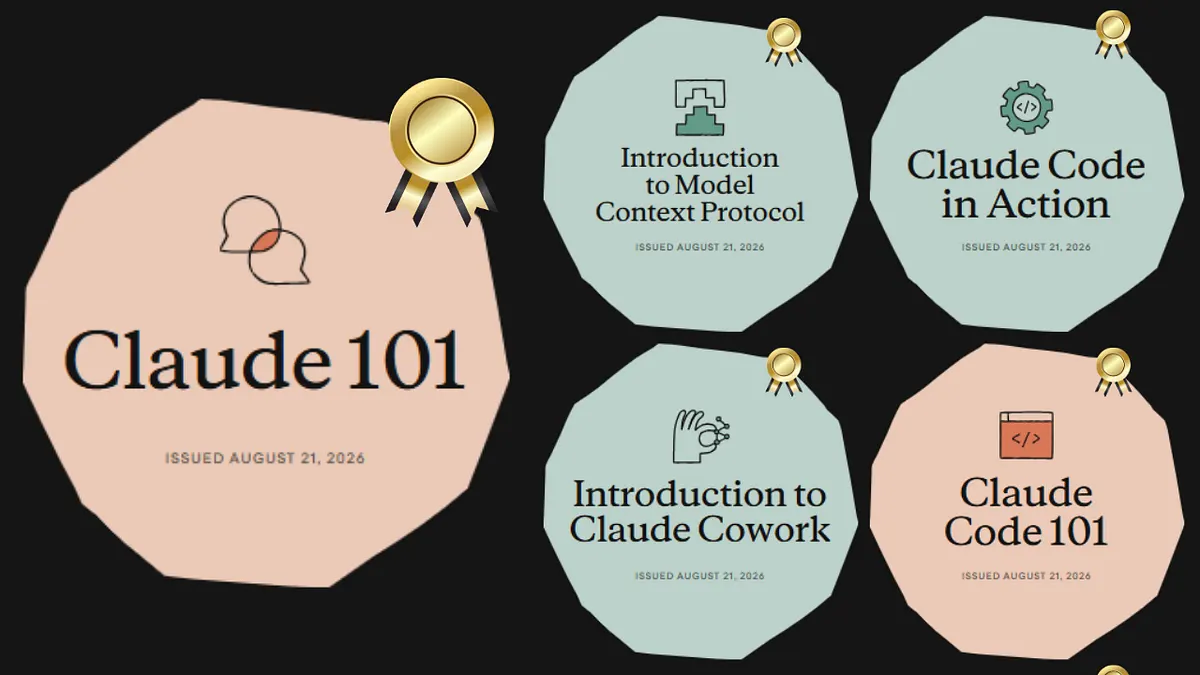
The era of watching scattered YouTube videos to learn "prompt hacking" is officially over. On August 20, Anthropic launched Claude Academy, a sprawling, free educational platform designed to teach anyone how to turn raw artificial intelligence into reliable, automated workflows. It is a calculated move to solve the AI industry's biggest current bottleneck: actually getting normal businesses to use these tools effectively.
The End of the Prompt Hacker
Claude Academy arrives with more than 16 free, self-paced courses spanning Anthropic’s entire modern software stack, from basic chat interfaces to complex development environments like Claude Code and Claude Tag. Instead of teaching users cheap tricks to trick an AI into doing what they want, the academy focuses on structural integration.
At the center of this curriculum is Anthropic's internal training model, now open to the public: the 4D AI Fluency Framework. The courses break down AI management into Delegation, Description, Discernment, and Diligence. This shifts the user's role from a typist hoping for a good answer to a manager directing a highly capable, if sometimes literal-minded, digital intern.
“As models shift from simple chat to full agentic workflows, the hardest part isn't prompting - it's knowing how to build, delegate, and manage context.”— KP
AI models are now smart enough to infer basic commands. What users actually lack is judgment—how to critically assess an AI's output and ethically delegate tasks. By standardizing this education, Anthropic is trying to create a universal language for human-AI collaboration.
The Trillion-Dollar Training Play
This educational rollout didn't happen in a vacuum. It landed the exact same week Anthropic pushed several massive developer tools to General Availability, including highly anticipated "Computer Use" capabilities that allow their AI to interact directly with desktop environments. But powerful tools are useless if enterprise IT departments are too intimidated to deploy them.
Investors are watching closely to see if Anthropic can cross the $1.25 trillion valuation mark by the end of 2026. To justify that kind of staggering math, the company needs massive legacy organizations to embed Claude into their daily operations.
Historically, the companies that train the workforce win the market. Claude Academy mirrors the rise of Salesforce Trailhead in the 2010s and AWS Certification in the 2000s. In both eras, cloud technology evolved far faster than university curricula could adapt. Platform vendors realized that if they didn't single-handedly upskill the global workforce for free, no one would know how to buy their enterprise products.
Surviving the Multi-Agent Trap
As users transition from simple chat windows to complex, multi-agent architectures, they immediately run into a new set of technical traps. The most common is the "Trial and Error Trap" of task delegation. When should a developer split a massive task among five different AI subagents, and when should they just dump everything into one massive context window?
Over-splitting wastes time and compute on constant handoffs between agents. Under-splitting overwhelms the AI's memory, leading to missed instructions and hallucinations.
Claude Academy addresses this directly through role-based pathways and real-world cookbooks rather than abstract documentation. By installing a specific "Claude Academy Skill" within the platform, users even get a personalized learning path tailored directly to the architectural mistakes they are making in their own workflows.
The Democratization of Judgment
Anthropic's move signals that the technical story and the education story are now one and the same. As a Public Benefit Corporation deeply invested in "Constitutional AI," Anthropic recognizes that the safest way to deploy powerful intelligence is to ensure the humans holding the leash actually know what they are doing.
But the broader implication is the democratization of engineering itself. By offering dedicated developer tracks on configuring AI subagents for free, the barrier to entry for building sophisticated corporate software is plummeting.
The future of work belongs to the orchestrators. The most valuable skill in the coming decade won't be writing the code yourself, but knowing how to direct a team of digital agents to write, test, and deploy it for you. Claude Academy is just the first formalized school for that exact future.
What people are saying

“Claude Academy is now live. Whether you're figuring out what AI is or already using Claude every day, there's a path that meets you where you are. The courses and tutorials are free and open to anyone at”

“Anthropic has launched the Anthropic Academy I took a look at the Anthropic Academy, and I have to admit that I consider it a useful foundation. AI is increasingly being used across a wide range of fields. At the same time, we should not forget that we operate in something of an”


“Anthropic just dropped a 37 minute guide on building AI agents that automate an entire company. Free. From the engineers who built Claude. Agents that work, split tasks between each other and execute on their own. Save this🔖”
Anthropic's Path to $1.25T
More stories